.png)

Originally developed in the 2000s by Tandberg (Norway) and later acquired by Cisco, TMS has long been the global reference for video conferencing infrastructure management. Its end-of-life now forces thousands of organisations to modernise their tools while preserving strong administrative control.
Below is an updated, factual overview of the most credible options in 2025.
Cisco has formally announced the progressive retirement of TelePresence Management Suite (TMS) and the TMSXE extension:
After this date, no more security patches, fixes or technical assistance will be provided. Cisco suggests solutions such as Webex Hybrid Calendar, VQ Conference Manager and Synergy SKY as potential migration paths.
Teams who previously relied on TMS generally look for solutions capable of maintaining:
Interoperability (Teams/Zoom/Google) and SIP registration can be useful additions, but they are not core TMS functions and should not drive the primary decision.
.svg.png)
Developed in the UK, VQ Conference Manager is a mature option for infrastructures based on Cisco Meeting Server (CMS).
It replicates the TMS functions that are most commonly used in CMS deployments: scheduling, resource management and consolidated reporting.
Strengths :
Limitations :
Best suited for organisations remaining fully invested in the Cisco CMS ecosystem.

Based in Norway, Synergy SKY focuses on simplifying meeting workflows and ensuring reliable, calendar-driven OBTP.
It is not a full administrative replacement for TMS, but a strong modernisation layer for meeting experience and room readiness.
Strengths :
Limitations :
Ideal for organisations prioritising meeting workflow reliability and end-user experience.

Developed in Sweden, Mividas extends the TMS philosophy with a 100% software-based, on-premise architecture.
It combines device management, meeting scheduling, automation and deep monitoring into a unified interface compatible with Cisco and Pexip Infinity.
Strengths :
Limitations :
Ideal for organisations that want a modern, on-prem, TMS-level administration platform.
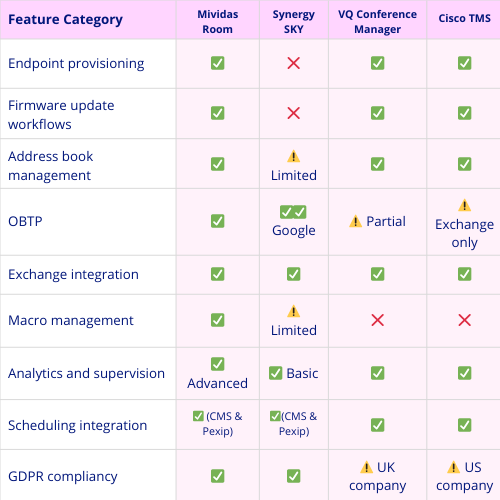
By combining Mividas for administration and automation, Synergy SKY for meeting workflow reliability, and VQ CM for CMS-centric infrastructures, European organisations can rebuild a stable, secure and sovereign post-TMS environment.
Miles Distribution supports integrators, vendors and end-users with technical assessments, evaluations and deployments across all three solutions.
👉 Download our white paper “Life After Cisco TMS” November 2025
👉 Or schedule a call with our engineering team to discuss your post-TMS strategy
Is Cisco TMS officially discontinued?
Yes. Cisco has officially announced the end of life of Cisco TelePresence Management Suite (TMS). The product is no longer sold, and support will end in January 2027. After this date, no security patches, updates or technical assistance will be provided.
What is the best Cisco TMS replacement in 2026?
There is no single one-size-fits-all replacement. For organisations looking to preserve on-premises device management, scheduling and room automation, platforms such as Mividas, Synergy SKY and VQ Conference Manager are the most credible Cisco TMS replacement options in 2025 and 2026.
The right choice depends on the organisation’s infrastructure, governance requirements and long-term collaboration strategy.
Can Cisco TMS be replaced without moving to the cloud?
Yes. Several Cisco TMS alternatives support on-premises or hybrid deployments. This is a key requirement for organisations operating in regulated or sovereign environments where full cloud migration is not an option.
Does Webex Hybrid Calendar replace Cisco TMS?
No. Webex Hybrid Calendar covers meeting scheduling use cases but does not replace Cisco TMS core capabilities such as device provisioning, room automation, macro management or advanced monitoring.
What happens if we keep Cisco TMS after end of support?
Running Cisco TMS beyond its end of support exposes organisations to increasing security, compliance and operational risks. Without updates or patches, the platform will gradually become incompatible with modern collaboration environments.