
Android video bars transformed the way organisations deploy meeting rooms. Simple to install, affordable, reliable — they became the default architecture for thousands of companies rolling out Microsoft Teams Rooms, Zoom Rooms or Google Meet at scale.
But that widespread adoption has created a risk that few organisations anticipated.
The software support lifecycle of an Android OS embedded in a video conferencing appliance is short — typically around three years. Once that window closes, the underlying OS stops receiving security updates. The device keeps working. Users keep joining meetings without a second thought. But the risk accumulates, silently.
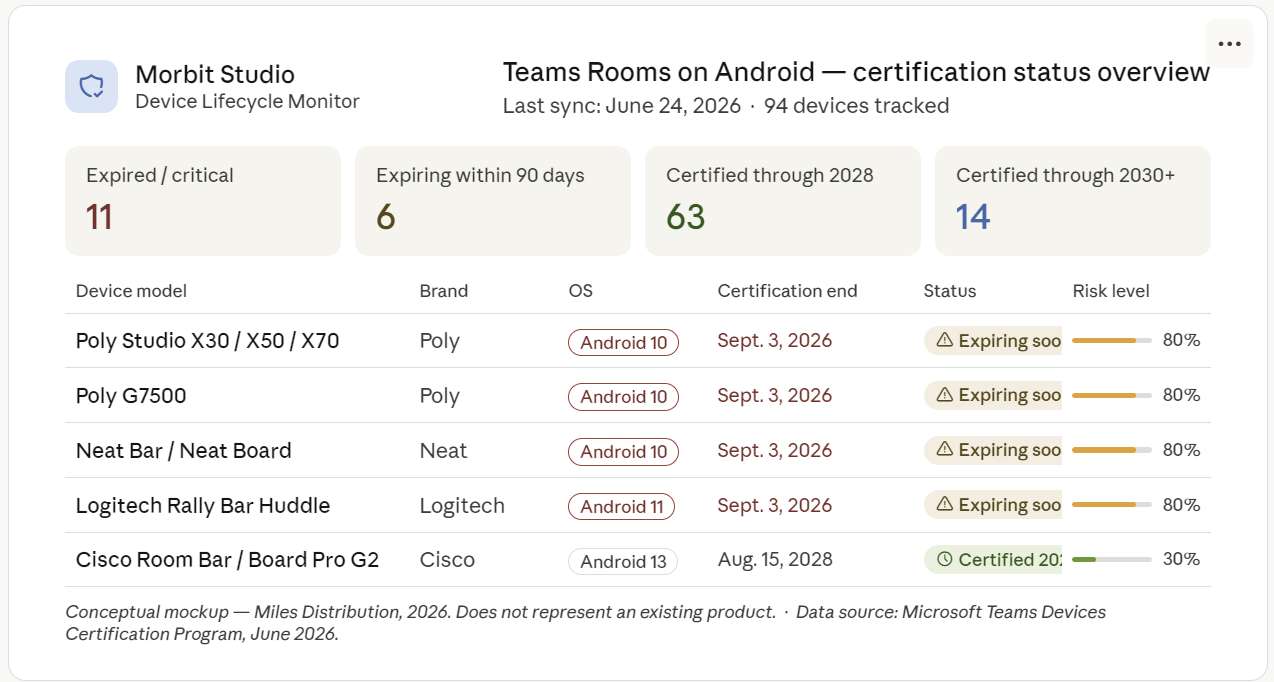
Microsoft publishes and regularly updates the official Teams Rooms on Android certification list. It states, for every certified device, the embedded Android OS version and the certification end date. The data is public, precise and unambiguous.
What we are seeing with Android MTR systems is not an isolated industrial accident. It is a structural pattern that repeats with every technology generation.
— 2024: Windows 10 end of support. Millions of devices affected worldwide.
— 2026: Android 10 / 11 Teams Rooms certification expiry. Poly, Neat, Logitech among the brands affected.
— 2028+: The cycle will repeat. Devices certified today will reach their own end-of-support window.
IT teams know this cycle well on the PC side — they have processes, budgets and tooling to manage it. What they do not yet have is the equivalent for meeting rooms. That is precisely where the gap lies.
These devices are present in tens of thousands of meeting rooms across Europe and beyond. They will not be decommissioned overnight. They will keep functioning. And that is precisely where the danger lies.
A properly equipped meeting room contains many connected components: a video bar or codec, a touch console, a remote camera, a ceiling microphone, an interactive display, sometimes a content sharing system.
Each of these devices has its own firmware, its own OS version, its own end-of-support date — independent of every other component in the same room.
A video conferencing system is not a passive audiovisual peripheral. It is a fully-fledged network endpoint — with an active camera, an open microphone, authentication tokens, and permanent access to the corporate network.
These devices are physically present in the spaces where the organisation's most sensitive conversations take place: boardrooms, negotiation rooms, executive suites.
An unmaintained OS on this type of device is an open attack surface on the entire corporate network. No security fixes. No vulnerability patches. No updated authentication mechanisms.
Would you leave an open microphone in your boardroom without keeping it up to date?
As CISOs extend their supervision perimeter to every network endpoint, the meeting room can no longer remain a blind spot.
Simon Anthony Walker wrote in November 2025:
"Devices limited to a specific operating system version quickly hit a wall. Certification updates stop. Security patching slows or ceases entirely. Compliance becomes uncertain. What seemed like a future-proof deployment suddenly turns into a looming replacement headache."
He was right. And he will be right again in two years, when today's Android 13-certified devices reach their own end-of-cycle.
This is not an argument for replacing all your devices on a rolling basis. It is an argument for having the right tooling in place permanently tooling that tracks the lifecycle of every device, alerts before deadlines arrive and enables informed decision-making at scale.
The first step is visibility: knowing precisely what is running in each room, on which OS, with which firmware version, and when that support ends.
IT and security teams gain a unified, real-time view of the entire estate. They can prioritise actions, anticipate risks and plan renewals over time — not in reaction to a crisis, but ahead of it.
Morbit Studio can audit your estate within hours. Identify at-risk devices before the problem becomes a security incident.