

In most environments we encounter at Miles Distribution, IT teams don’t lack tools. What they lack is a consolidated view of what they manage; and without that view, support stays reactive, incidents repeat and field visits accumulate.
That is precisely the problem Morbit Studio addresses.
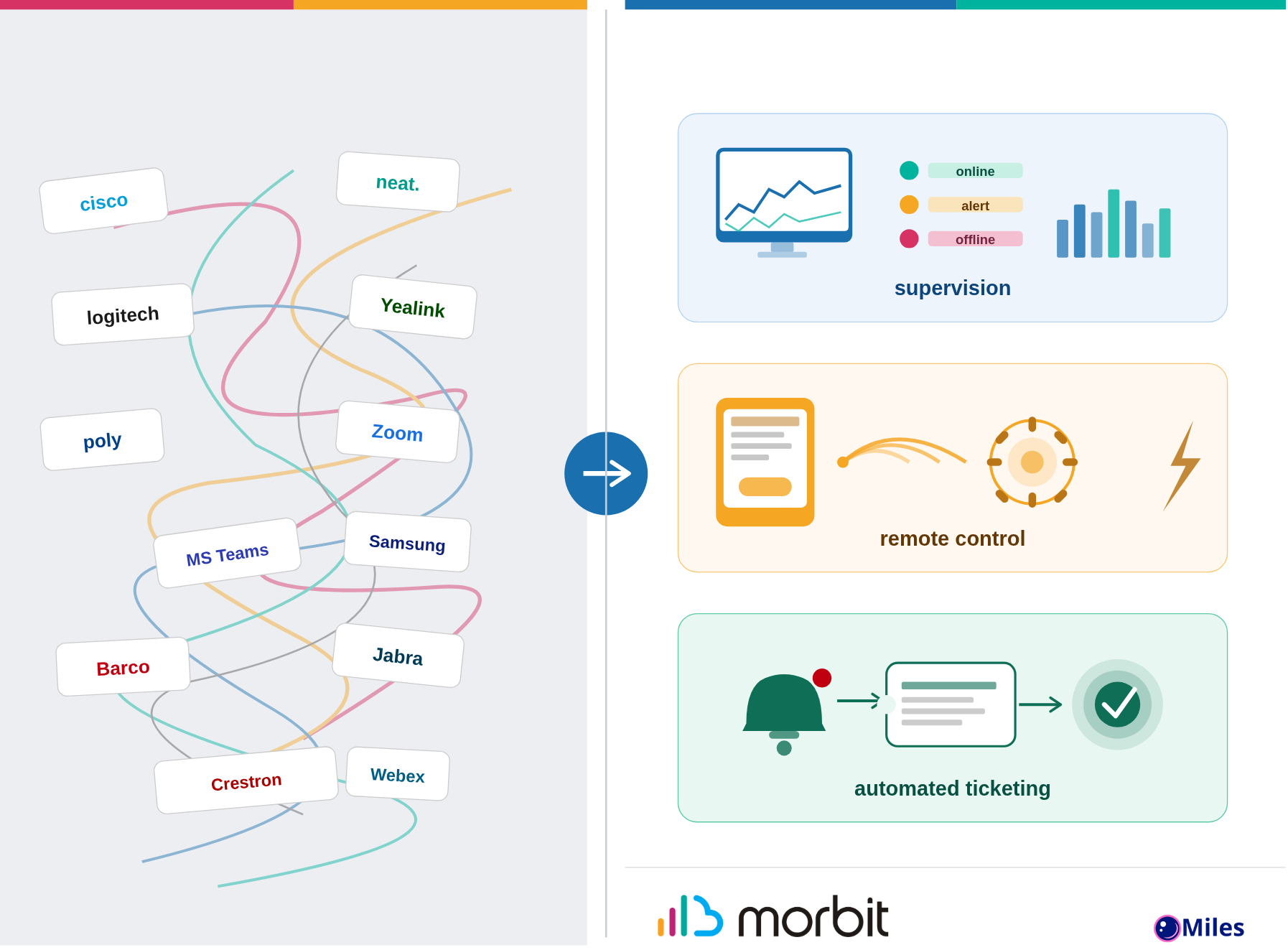
A modern collaboration environment is rarely homogeneous. Microsoft Teams Rooms sits alongside Zoom, Cisco, Poly, Yealink, Logitech or Neat devices, Samsung displays, users in meeting rooms and working remotely. Each component is managed in its own tool, with its own alerts, its own dashboard.
The result is predictable: blind spots. Unregistered devices, firmware never updated, configurations drifting silently. These blind spots make no noise until they generate an incident, usually at the worst possible moment.
Morbit Studio starts from a simple observation: monitoring alone is no longer enough. Knowing a device is faulty solves nothing if you then have to navigate three tools to understand the cause and send a technician on site to fix it.
The platform first delivers a complete map of the environment: physical assets (collaboration bars, room controllers, IP phones, displays) and digital assets (Teams policies, meeting configurations, accounts and licences). Everything is centralised in a single interface, regardless of vendor.
The next step is remote action. Firmware deployment, configuration correction, fleet standardisation: operations that previously required a site visit or manual intervention become manageable directly from the platform. This is where the ratio between operational load and value delivered starts to shift.
A user reports a poor-quality meeting. Without the right tool, the investigation takes time: who was present, which device was used, what was the network state at that moment. With Morbit Studio, the analysis is immediate; a few clicks identify whether the cause is unstable Wi-Fi, packet loss or a faulty peripheral.
This shift from assumption to fact is structurally important for an IT team managing a large estate.
Detecting a problem only has value if it triggers action. Morbit Studio integrates with ticketing tools such as Freshdesk to automate ticket creation, attach full technical context and route them to the right teams. The alert does not stay as an indicator; it immediately becomes a workflow.
The figures published by Morbit, a solution deployed across 50+ countries, are clear:
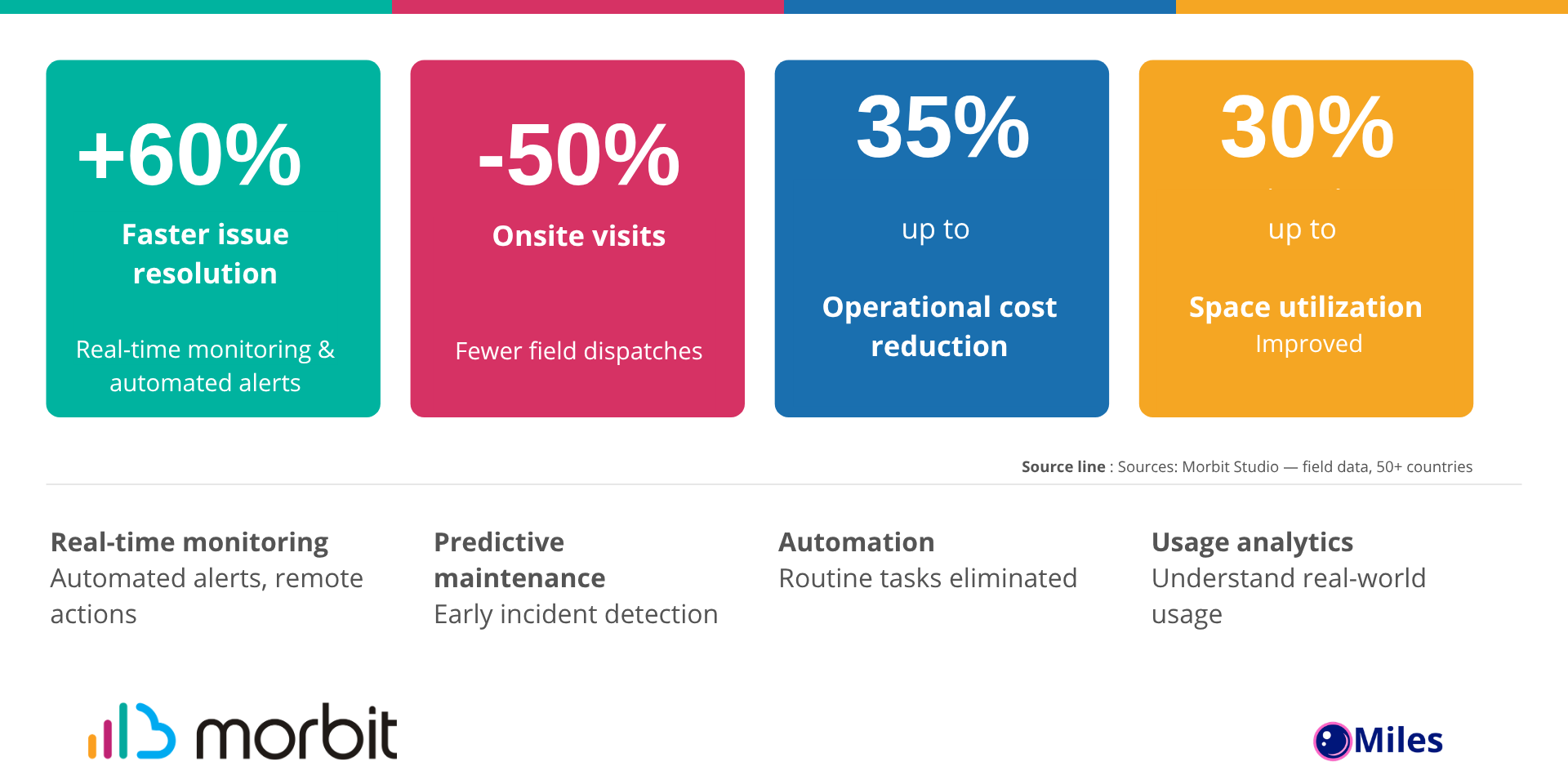
That last point deserves attention. Improved space utilisation goes beyond IT; it directly affects real estate management and hybrid work organisation. It is a metric that executive teams understand as well as IT directors.
Morbit Studio is built natively for multi-tenant management. For a partner like Miles Distribution managing environments across multiple clients, this means centralised supervision, large-scale deployments and operational automation that reduces workload without reducing service levels.
It is a shift in model: from incident-driven management to anticipation-driven management. Less reactive support, more proactive value delivered.
We selected it because it addresses challenges we see concretely in the field. Clients managing mixed fleets, distributed or security-sensitive environments, teams reacting to their support rather than controlling it: these are exactly the profiles for which this platform makes a measurable difference.
If you want to see how this applies to your environment, we run 30-minute technical walkthroughs with an engineer — no slides, focused on your specific context. Just reach out: CONTACT
