There is a conversation that rarely happens openly in collaboration environments: the fact that meeting rooms deployed five or ten years ago no longer know what to connect to. Platforms have changed, usage patterns too, and between a Cisco room running on on-premise infrastructure and a Teams meeting hosted somewhere in a cloud nobody really controls, there is often a gap that IT teams bridge by force, most of the time by replacing hardware that still works perfectly well and drawing down budgets in the process.
That is precisely the problem Synergy SKY chose to solve, from Oslo, since 2008.
What sets Synergy SKY apart from the start is consistency. They do not do network monitoring, workplace analytics, or device management. They do video interoperability, and only that. In a market where most vendors expand their scope at the first opportunity, that discipline is a signal in itself.
It translates concretely into a patent granted in March 2023, protecting the technical architecture that allows a SIP endpoint to join a meeting hosted on a web platform, whether Teams, Zoom or Google Meet, through a virtual web participant generated server-side. This is not an administrative formality. That intellectual property protection is a genuine asset for Synergy SKY, one they build on every day to develop software designed to last, not a surface-level integration that a competitor could work around tomorrow.
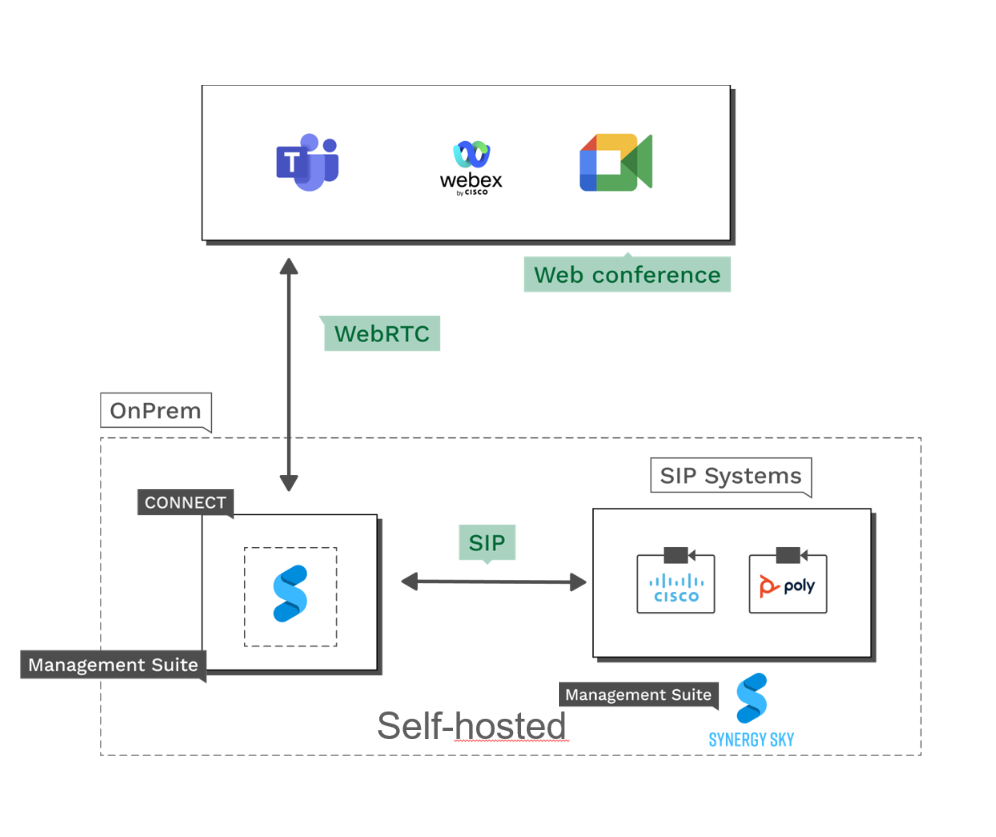
Synergy SKY Connect is a software platform that connects Cisco, Poly and SIP rooms to major cloud platforms without touching the existing infrastructure. No migration, no hardware replacement, no endpoint registration on a third-party service.
OBTP, One Button to Push, works even when the room is not natively compatible with the destination platform. Content sharing and dual screen are preserved. Users join their meetings exactly as they always have; the system adapts, not them.
Connect also covers use cases I hear about regularly in the field. The One Time VMR is a good example: rather than a permanent virtual room with a fixed link accessible at any time, Connect can generate a single-use VMR tied to a specific meeting and expired once it ends. For security-conscious organisations, that distinction matters.
Cisco TMS is approaching end of life. This is no longer a roadmap rumour; it is a reality IT teams have to plan for. And the question most organisations are asking is not just "what do we replace it with?" but "can we migrate without breaking everything?"
Connect is one answer to that question, and not just any answer. Part of the Synergy SKY founding team was already involved in TMS development back in the Tandberg days, before the Cisco acquisition. They know that architecture from the inside: its strengths, its constraints, and above all the real operational needs of the organisations that have relied on it for years. That accumulated experience shaped the design of Connect, and explains why the solution fits so naturally into even the most demanding environments.
The transition does not mean starting from scratch. It means replacing the management layer while keeping what works, and gaining capabilities TMS never offered: native interoperability with cloud platforms, support for multiple calendar types, recurring meeting management without the limitations of the old architecture. For organisations that have invested in Cisco hardware, it is a way to extend that investment rather than write it off.
On-premise deployment of Connect is not a niche option. It is an architecture that adapts to virtually any existing or planned infrastructure, and one whose demand is becoming the norm across the French and European market.
Public administrations, critical infrastructure operators, industrial organisations bound by confidentiality requirements cannot accept video streams transiting through infrastructure they do not control, neither in terms of location nor access conditions. Connect deploys on-site, without cloud dependency, GDPR-compliant. In the French context specifically, this opens up the concrete ability to ensure interoperability between existing SIP rooms and meetings hosted on qualified sovereign environments. A Cisco room can join a Teams meeting without the stream passing through Azure US. Very few players can credibly make that claim today.
Synergy SKY is a Cisco partner. Connect integrates into Cisco environments with technical compatibility that is documented and maintained over time. That partner status makes conversations with existing teams easier; it does not replace the expertise needed to qualify a requirement, anticipate integration friction and provide real follow-through. That is what we bring at Miles Distribution.
What matters equally to me is that this partner status creates no exclusive dependency. Connect runs on Poly endpoints, on generic SIP systems, in multi-vendor environments where Cisco is just one component among others. That is precisely the definition of Open Video Interoperability: interoperability that does not depend on the goodwill of a single platform.
A hundred Cisco rooms deployed, a TMS reaching end of life, users scheduling everything on Teams, an IT director asking for guarantees on video streams: that is a scenario I come across regularly. Connect addresses all of those constraints without forcing a choice between performance, security and operational continuity.
That is what I call a solution built around the real problem, not around a product catalogue.